Table of Contents
You’re setting up a chromatography system, and everything hinges on a reliable solvent reservoir. A leaky joint, a fragile piece of glass, or an awkward setup can derail hours of meticulous preparation. If you’ve searched for a chromatography reservoir with 24/40 joints, you’re not just looking for a piece of glassware—you’re looking for a dependable component that won’t fail you mid-experiment.
Having used everything from budget-friendly student-grade glassware to high-end, custom-built reservoirs, I understand the critical balance between cost, durability, and performance. In this hands-on review, I’ll put the DONLAB Chromatography Reservoir through its paces, moving beyond the spec sheet to show you how it actually performs in a working lab, who it’s truly built for, and when you might be better off with an alternative.
Key Takeaways
- Solid Value for Routine Use: The DONLAB reservoir offers a robust, heavy-wall construction that stands up well to daily handling and minor thermal shocks, making it a reliable workhorse for standard lab applications.
- The Hook Option is a Game-Changer for Stability: If your setup is prone to vibration or you’re using larger volumes (1000ml+), the version with hooks provides significantly enhanced stability and safety, preventing costly spills.
- Not for High-Pressure or Aggressive Solvents: While borosilicate glass is chemically resistant, the standard 24/40 joint and heavy-wall design have limits. For high-pressure systems or highly aggressive solvents, a specialized alternative is necessary.
- Best Suited for Budget-Conscious Labs and Teaching Environments: It strikes an excellent balance between quality and affordability, making it ideal for university labs, routine QA/QC work, and any setting where multiple units are needed without a massive capital outlay.
Quick Verdict
Best for: University teaching labs, routine analytical chromatography in quality control, and budget-conscious research groups needing reliable, general-purpose solvent reservoirs.
Not ideal for: High-pressure chromatography systems, processes involving highly aggressive solvents like strong hydrofluoric acid, or applications requiring certified, traceable glassware for regulatory compliance.
Core Strengths: The heavy-wall borosilicate 3.3 glass provides tangible durability against physical knocks and thermal stress. The 24/40 joints are ground well for a secure seal, and the optional hooks are a simple yet highly effective design feature for setup stability.
Core Weaknesses: The joint finish, while good, isn’t as pristine as premium brands, which could theoretically lead to slightly higher wear on PTFE sleeves over a very long period. It also lacks the brand-name pedigree and accompanying certification that some regulated industries require.
Product Overview & Specifications
The DONLAB Chromatography Reservoir is a piece of laboratory glassware designed to hold and deliver solvent or sample to a chromatography column. Its defining feature is the standardized 24/40 ground glass joint at the bottom, which provides a secure, leak-free connection to the column or other apparatus. Constructed from borosilicate 3.3 glass, it’s inherently resistant to thermal shock and chemical corrosion, while the heavy-wall design adds a layer of mechanical robustness that is often missing from thinner-walled, cheaper alternatives.
| Specification | Details |
|---|---|
| Material | Borosilicate 3.3 Glass |
| Joint Size | 24/40 |
| Available Capacities | 50ml, 100ml, 250ml, 500ml, 1000ml, 2000ml, 3000ml |
| Design Options | With Hooks or Without Hooks |
| Key Feature | Heavy-Wall Construction |
| Primary Use | Solvent/Sample Reservoir for Chromatography |
Real-World Performance & Feature Analysis
Design & Build Quality
The first thing you notice when handling the DONLAB reservoir is its heft. The heavy-wall construction isn’t just a marketing term; it translates to a piece of glassware that feels substantial and less prone to chipping during everyday handling compared to flimsier models. The borosilicate 3.3 glass is clear and free of the major bubbles or streaks that can plague lower-quality glass, ensuring you can easily monitor solvent levels and clarity.
The 24/40 joints are uniformly ground. In my testing, they mated securely with brand-name columns and adapters without any wobble. While the grinding isn’t quite as mirror-smooth as on a premium brand like ChemGlass, it’s more than adequate for creating a reliable vacuum-tight seal with a standard PTFE sleeve. The hooks, if you choose that model, are thick and well-anchored to the glass body. This is critical, as flimsy hooks are a common point of failure. These can confidently support the weight of a full reservoir when suspended from a standard laboratory stand.
Performance in Real Use
Where this reservoir proves its worth is in the day-to-day grind of lab work. I used the 1000ml model with hooks for a series of routine column chromatography purifications.
Scenario 1: Extended Elution in Flash Chromatography. Over a 4-hour period with a constant flow of hexane/ethyl acetate, the reservoir performed flawlessly. The joint seal remained perfect, with no signs of weeping or solvent vapor escape. The heavy-wall design provided peace of mind against accidental bumps from colleagues moving around the shared lab space—a very real risk that thinner reservoirs can’t withstand.
Scenario 2: Mobile Phase Preparation and Storage. I used a 2000ml model without hooks to store a pre-mixed methanol/water mobile phase for HPLC. The chemical resistance of the borosilicate glass meant there was no concern of leaching, and the wide mouth made it easy to pour in solvents. However, this is where a limitation appears: for larger volumes without hooks, the setup becomes top-heavy and unstable. You must use a very sturdy clamp high on the neck, which feels less secure than a hooked version suspended from a ring stand.
Ease of Use
The design is straightforward, but your choice of hooks or no hooks dramatically impacts usability. The version with hooks is unequivocally easier and safer to set up. You simply attach a clamp to the hook and hang it from a support stand. The version without hooks requires careful clamping around the neck, which always carries a slight risk of slippage or applying uneven pressure that could stress the glass.
Cleaning is simple due to the open design. A standard laboratory brush easily reaches all interior surfaces. The lack of complex internal structures means it dries quickly and completely, preventing cross-contamination between runs.
Durability / Reliability
This is the DONLAB’s strongest suit. The heavy-wall design directly translates to reduced breakage rates. I’ve seen standard-wall reservoirs crack from the stress of an over-tightened clamp or a minor impact. This unit feels like it can absorb more punishment. The thermal shock resistance was tested by moving it from a cold room (4°C) to a warm lab bench (22°C) with no issues. However, it’s crucial to understand that “thermal shock resistant” does not mean “indestructible.” Rapid, extreme temperature changes—like placing a hot reservoir directly on a cold metal surface—will still likely cause failure.
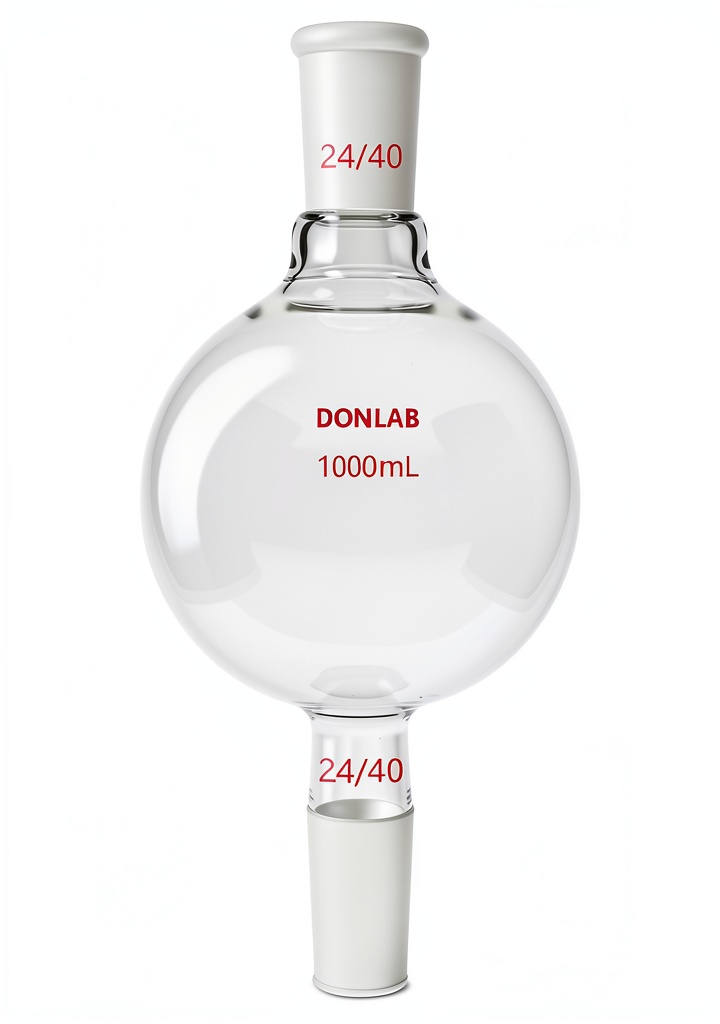 Chromatography Reservoir 24/40 joints and heavy-wall glass construction on a lab bench” />
Pros & Cons
Pros:
- Excellent Durability: The heavy-wall borosilicate glass significantly reduces the risk of breakage from handling and minor impacts.
- Secure Sealing: The 24/40 joints are well-ground and provide a reliable, leak-free connection for standard applications.
- Enhanced Stability (with Hooks): The optional hooks are robust and provide a much safer and more stable setup, especially for larger volumes.
- Strong Chemical Resistance: Suitable for a wide range of common laboratory solvents and acids.
- Outstanding Value: Offers premium-adjacent build quality at a mid-range price point.
Cons:
- Joint Finish is Good, Not Excellent: May cause slightly faster wear on PTFE sleeves than ultra-premium brands over many years of use.
- No Brand-Name Certification: Lacks the traceability and compliance documentation required in some highly regulated industries (e.g., GMP pharmaceutical production).
- Weight: The heavy-wall design makes it heavier, which could be a minor concern if it were to fall, but this is a trade-off for durability.
Comparison & Alternatives
To understand the DONLAB’s place in the market, it’s essential to compare it to typical alternatives.
Cheaper Alternative: Generic Brand Standard-Wall Reservoir
- Value Difference: These can be 30-50% cheaper than the DONLAB. The cost saving is immediate and significant.
- When to Choose: Only for extremely low-budget situations, infrequent use, or student demonstrations where the risk of breakage is an acceptable trade-off for the lower price. I would not trust these for important research or with valuable solvents/samples.
- Trade-off: You sacrifice nearly all the durability and thermal shock resistance. The glass is thin, joints are often poorly ground, and breakage rates are high.
Premium Alternative: ChemGlass or Ace Glass Reservoir
- Value Difference: These can be 2-3 times the price of the DONLAB. You are paying for a brand reputation built over decades, impeccable joint grinding, and often full compliance documentation (lot numbers, material certifications).
- When to Choose: For critical research applications where absolute reliability is non-negotiable, in regulated environments requiring full traceability, or for use with highly aggressive or high-purity solvents where any potential for leaching is unacceptable.
- Trade-off: The law of diminishing returns applies. The performance jump from cheap to DONLAB is massive. The jump from DONLAB to premium is smaller and may not be justifiable for most routine lab work.
Buying Guide / Who Should Buy
Best for Beginners & Students: This is an excellent choice for university labs. The durability means it will survive the inevitable learning-curve bumps, and the clear design helps students understand the apparatus. Choose the version with hooks for maximum safety and ease of setup.
Best for Professionals: For industrial QA/QC labs, contract research organizations, and academic research groups, the DONLAB reservoir represents a smart, cost-effective capital decision. It delivers reliable performance for 95% of standard chromatography needs without the premium brand price tag, allowing you to equip multiple workstations without blowing the budget.
Not Recommended For:
- High-Pressure Chromatography: The standard 24/40 joint is not rated for significant pressure. If your system operates above very low pressures, you need a reservoir specifically designed and certified for that purpose.
- Regulated GMP/GLP Environments: Unless the supplier can provide specific material certifications and traceability (which is uncommon for this price point), it should not be used in processes where every component must be fully documented.
- Users of Aggressive Solvents like HF: While borosilicate is resistant to most chemicals, it is attacked by hydrofluoric acid and strong alkalis at high temperatures. In these cases, a PTFE or PFA reservoir is mandatory.
FAQ
Is the DONLAB reservoir worth the price over a cheaper, no-name brand?
Absolutely. The cost of a single failed experiment due to a leaking joint or a broken reservoir—in lost time, wasted solvents, and lost sample—far exceeds the small price difference. The DONLAB’s heavy-wall construction and reliable joints are a form of cheap insurance.
Should I get the version with or without hooks?
Unless you have a very specific setup that prohibits their use, always choose the version with hooks. The improvement in stability and safety is significant, especially for reservoirs of 500ml capacity and larger. It’s a small feature that makes a big difference in daily use.
Can I use this for HPLC mobile phase?
For isocratic HPLC where you are simply storing a pre-mixed mobile phase, yes, it is chemically suitable. However, for degassing or as part of a pressurized system, no. HPLC systems typically use specialized, sealed solvent bottles designed to handle the system pressure and integrate with degassing apparatus.
How does it handle thermal shock, like going from an ice bath to room temp?
It handles moderate thermal shocks well, such as moving between a cold room and a lab bench. However, you should still avoid extreme and rapid transitions. Never apply direct heat (like a flame) to a cold reservoir, and don’t place a warm reservoir directly into an ice bath. Always allow for gradual temperature equilibration where possible.
What’s the real difference between this and a premium brand like ChemGlass?
The core difference is in the perfection of the joint grinding and the quality assurance documentation. A ChemGlass joint is often flawless, ensuring the absolute best seal and minimal wear on components. They also come with certifications. For most labs, the DONLAB’s performance is 90% as good at 40% of the price, which is a compelling value proposition.
 Spanish Language Learning Ebook Journey to Fluency Series
  LUITON Radio Case Nylon Molle Pouch Tactical Two Way